3 Things That Can Make a Sonic Boom

The sound source is travelling at 1.4 times the speed of audio (Mach 1.4). Since the source is moving faster than the sound waves it creates, it leads the advancing wavefront.

A sonic boom produced by an aircraft moving at G=2.92, calculated from the cone angle of 20 degrees. Observers hear zero until the shock wave, on the edges of the cone, crosses their location.


NASA data showing N-wave signature.[1]

Conical shockwave with its hyperbola-shaped ground contact zone in yellowish
A sonic boom is a audio associated with shock waves created when an object travels through the air faster than the speed of sound. Sonic booms generate enormous amounts of audio energy, sounding like to an explosion or a thunderclap to the homo ear. A decibel is the principal unit measurement of sound. "A thunderclap is incredibly loud, producing levels betwixt 100 and 120 dBA (decibels A)- the equivalent of standing near a jet during accept-off." (Skilling & WGN-TV, 2021)
The crack of a supersonic bullet passing overhead or the cleft of a bullwhip are examples of a sonic smash in miniature.[ii]
Sonic booms due to large supersonic aircraft tin be particularly loud and startling, tend to awaken people, and may crusade minor damage to some structures. This led to prohibition of routine supersonic flight overland. Although they cannot be completely prevented, research suggests that with conscientious shaping of the vehicle, the nuisance due to the sonic booms may be reduced to the indicate that overland supersonic flight may become a viable choice.[3] [iv]
A sonic boom doesn't occur the moment an object crosses the sound barrier; and neither is it heard in all directions emanating from the supersonic object. Rather the boom is a continuous effect that occurs while the object is travelling at supersonic speeds. But information technology affects only observers that are positioned at a betoken that intersects a region in the shape of a geometrical cone behind the object. As the object moves, this conical region as well moves behind it and when the cone passes over the observer, they will briefly experience the boom.
Causes [edit]
When an aircraft passes through the air, it creates a serial of pressure waves in front of the aircraft and behind it, similar to the bow and stern waves created by a boat. These waves travel at the speed of audio and, as the speed of the object increases, the waves are forced together, or compressed, because they cannot become out of each other's manner rapidly enough. Eventually they merge into a unmarried shock wave, which travels at the speed of audio, a critical speed known equally Mach 1, and is approximately 1,235 km/h (767 mph) at sea level and xx °C (68 °F).
In smooth flight, the shock moving ridge starts at the nose of the aircraft and ends at the tail. Because the different radial directions effectually the aircraft's direction of travel are equivalent (given the "smooth flight" condition), the shock wave forms a Mach cone, similar to a vapour cone, with the shipping at its tip. The half-bending betwixt the direction of flying and the stupor wave is given by:

- ,
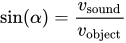
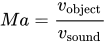
where is the changed of the plane's Mach number ( ). Thus the faster the plane travels, the finer and more than pointed the cone is.


At that place is a rising in pressure at the olfactory organ, decreasing steadily to a negative pressure at the tail, followed past a sudden return to normal force per unit area after the object passes. This "overpressure profile" is known every bit an N-wave because of its shape. The "boom" is experienced when at that place is a sudden alter in pressure; therefore, an N-moving ridge causes two booms – one when the initial pressure level-rise reaches an observer, and another when the pressure returns to normal. This leads to a distinctive "double boom" from a supersonic aircraft. When the aircraft is maneuvering, the pressure distribution changes into dissimilar forms, with a characteristic U-wave shape.
Since the smash is being generated continually as long as the aircraft is supersonic, it fills out a narrow path on the ground following the aircraft'south flying path, a fleck similar an unrolling red carpet, and hence known equally the boom carpet. Its width depends on the altitude of the aircraft. The altitude from the indicate on the ground where the boom is heard to the aircraft depends on its altitude and the angle .
For today's supersonic shipping in normal operating conditions, the elevation overpressure varies from less than 50 to 500 Pa (one to ten psf (pound per square human foot)) for an N-wave boom. Top overpressures for U-waves are amplified two to five times the N-moving ridge, but this amplified overpressure impacts only a very small area when compared to the expanse exposed to the balance of the sonic boom. The strongest sonic smash ever recorded was 7,000 Pa (144 psf) and it did not cause injury to the researchers who were exposed to it. The boom was produced by an F-4 flying just to a higher place the speed of audio at an altitude of 100 feet (30 1000).[5] In recent tests, the maximum nail measured during more realistic flight conditions was i,010 Pa (21 psf). There is a probability that some damage — shattered glass, for example — will result from a sonic boom. Buildings in good status should suffer no impairment by pressures of 530 Pa (11 psf) or less. And, typically, community exposure to sonic boom is below 100 Pa (2 psf). Ground motion resulting from sonic boom is rare and is well below structural damage thresholds accustomed by the U.S. Agency of Mines and other agencies.[6]
The ability, or volume, of the shock moving ridge depends on the quantity of air that is beingness accelerated, and thus the size and shape of the aircraft. As the aircraft increases speed the shock cone gets tighter around the arts and crafts and becomes weaker to the point that at very high speeds and altitudes no nail is heard. The "length" of the nail from front to back depends on the length of the aircraft to a power of 3/2. Longer aircraft therefore "spread out" their booms more than than smaller ones, which leads to a less powerful boom.[vii]
Several smaller shock waves tin can and usually practise form at other points on the aircraft, primarily at any convex points, or curves, the leading fly edge, and especially the inlet to engines. These secondary shockwaves are caused by the air being forced to turn effectually these convex points, which generates a shock moving ridge in supersonic menstruum.
The subsequently shock waves are somewhat faster than the get-go one, travel faster and add to the main shockwave at some distance abroad from the aircraft to create a much more divers Due north-wave shape. This maximizes both the magnitude and the "ascent time" of the shock which makes the boom seem louder. On most aircraft designs the feature distance is well-nigh xl,000 feet (12,000 m), meaning that below this altitude the sonic boom volition be "softer". However, the drag at this distance or below makes supersonic travel particularly inefficient, which poses a serious trouble.


A model of a supersonic aircraft made past Virgin Galactic hitting Mach 3.
Supersonic Shipping [edit]
Supersonic aircraft classifies any aircraft that can achieve flight faster than Mach i, which is supersonic. "Supersonic includes speeds up to five times Mach than the speed of audio, or Mach 5." (Dunbar, 2015) The superlative mileage per hour for a Supersonic Shipping normally ranges anywhere from 700 to i,500 miles per hour (1,100 to 2,400 km/h). Typically, most aircraft do not exceed 1,500 mph (2,414 km/h). There are many variations of supersonic aircraft. Some models of a supersonic aircraft make apply of better engineered aerodynamics that allow a few sacrifices in the aerodynamics of the model for thruster power. Other models utilise the efficiency and power of the thruster to permit a less aerodynamic model to achieve greater speeds. Typical model constitute in United States armed forces use ranges from an average of $13 million to $35 1000000 U.S dollars.
Measurement and examples [edit]
The pressure from sonic booms acquired by aircraft is often a few pounds per square foot. A vehicle flying at greater altitude will generate lower pressures on the ground, considering the shock wave reduces in intensity as information technology spreads out away from the vehicle, merely the sonic booms are less affected by vehicle speed.
| Aircraft | Speed | Altitude | Pressure (lbf/ft2) | Pressure level (Pa) |
|---|---|---|---|---|
| SR-71 Blackbird | Mach 3+ | 80,000 feet (24,000 m) | 0.nine | 43 |
| Concorde (SST) | Mach 2 | 52,000 feet (16,000 chiliad) | one.94 | 93 |
| F-104 Starfighter | Mach ane.93 | 48,000 feet (fifteen,000 m) | 0.8 | 38 |
| Space Shuttle | Mach 1.5 | 60,000 feet (18,000 g) | one.25 | sixty |
| Ref:[8] | ||||
Abatement [edit]

New inquiry is beingness performed at NASA's Glenn Research Eye that could help alleviate the sonic boom produced by supersonic aircraft. Testing was completed in 2010 of a Big-Scale Low-Boom supersonic inlet model with micro-array flow command. A NASA aerospace engineer is pictured hither in a air current tunnel with the Large-Scale Depression-Smash supersonic inlet model.
In the late 1950s when supersonic transport (SST) designs were being actively pursued, it was idea that although the blast would be very big, the problems could exist avoided by flight higher. This assumption was proven false when the Due north American XB-70 Valkyrie first flew, and it was establish that the nail was a trouble even at 70,000 feet (21,000 m). Information technology was during these tests that the N-moving ridge was beginning characterized.
Richard Seebass and his colleague Albert George at Cornell University studied the problem extensively and eventually defined a "figure of merit" (FM) to characterize the sonic boom levels of different aircraft. FM is a function of the shipping weight and the aircraft length. The lower this value, the less boom the shipping generates, with figures of nearly 1 or lower beingness considered acceptable. Using this calculation, they found FMs of about ane.four for Concorde and i.9 for the Boeing 2707. This eventually doomed near SST projects as public resentment, mixed with politics, somewhen resulted in laws that made any such shipping less useful (flying supersonically only over h2o for instance). Modest aeroplane designs like business jets are favoured and tend to produce minimal to no audible booms.[seven]
Seebass and George too worked on the trouble from a different bending, trying to spread out the N-moving ridge laterally and temporally (longitudinally), by producing a strong and downward-focused (SR-71 Blackbird, Boeing 10-43) shock at a sharp, but wide angle nose cone, which volition travel at slightly supersonic speed (bow stupor), and using a swept back flying wing or an oblique flight wing to smooth out this shock along the management of flight (the tail of the stupor travels at sonic speed). To adapt this principle to existing planes, which generate a shock at their olfactory organ cone and an even stronger 1 at their fly leading edge, the fuselage below the fly is shaped co-ordinate to the surface area rule. Ideally this would raise the characteristic altitude from 40,000 feet (12,000 thou) to 60,000 feet (from 12,000 m to eighteen,000 g), which is where nearly SST aircraft were expected to fly.[7]
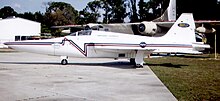
NASA F-5E modified for DARPA sonic boom tests
This remained untested for decades, until DARPA started the Quiet Supersonic Platform projection and funded the Shaped Sonic Blast Demonstration (SSBD) shipping to test it. SSBD used an F-5 Freedom Fighter. The F-5E was modified with a highly refined shape which lengthened the olfactory organ to that of the F-5F model. The fairing extended from the nose all the way back to the inlets on the underside of the aircraft. The SSBD was tested over a two-year period culminating in 21 flights and was an extensive study on sonic nail characteristics. After measuring the one,300 recordings, some taken within the stupor wave by a chase aeroplane, the SSBD demonstrated a reduction in boom by about one-tertiary. Although one-3rd is not a huge reduction, information technology could have reduced Concorde'due south boom to an acceptable level beneath FM = i.
As a follow-on to SSBD, in 2006 a NASA-Gulfstream Aerospace team tested the Quiet Spike on NASA-Dryden'south F-15B aircraft 836. The Quiet Fasten is a telescoping smash fitted to the nose of an aircraft specifically designed to weaken the strength of the shock waves forming on the nose of the aircraft at supersonic speeds. Over 50 test flights were performed. Several flights included probing of the shockwaves past a 2nd F-15B, NASA's Intelligent Flight Control System testbed, aircraft 837.
There are theoretical designs that practise not appear to create sonic booms at all, such as the Busemann biplane. However, creating a shockwave is inescapable if they generate aerodynamic lift.[7]
NASA and Lockheed Martin Aeronautics Co. are working together to build an experimental aircraft called the Depression Boom Flight Demonstrator (LBFD), which will reduce the sonic smash synonymous with high-speed flying to the sound of a car door closing. The agency has awarded a $247.5 million contract to construct a working version of the sleek, single-airplane pilot plane past summertime 2022 and should begin testing over the following years to determine whether the design could eventually be adjusted to commercial aircraft.[9]
Perception, noise and other concerns [edit]

A point source emitting spherical fronts while increasing its velocity linearly with time. For brusque times the Doppler consequence is visible. When v =c, the sonic blast is visible. When v >c, the Mach cone is visible.
The sound of a sonic boom depends largely on the distance between the observer and the aircraft shape producing the sonic nail. A sonic blast is usually heard as a deep double "boom" as the aircraft is normally some altitude away. The sound is much like that of mortar bombs, commonly used in firework displays. Information technology is a common misconception that merely one boom is generated during the subsonic to supersonic transition; rather, the boom is continuous along the boom carpet for the unabridged supersonic flying. Equally a sometime Concorde pilot puts it, "You don't actually hear anything on lath. All nosotros see is the pressure wave moving downward the aeroplane – information technology gives an indication on the instruments. And that's what we see around Mach 1. But we don't hear the sonic nail or anything like that. That's rather like the wake of a transport – it's behind united states of america."[10]
In 1964, NASA and the Federal Aviation Administration began the Oklahoma City sonic nail tests, which caused eight sonic booms per twenty-four hours over a period of six months. Valuable data was gathered from the experiment, merely xv,000 complaints were generated and ultimately entangled the government in a form-action lawsuit, which information technology lost on appeal in 1969.
Sonic booms were too a nuisance in North Cornwall and North Devon in the UK every bit these areas were underneath the flight path of Concorde. Windows would rattle and in some cases the "torching" (pointing underneath roof slates) would be dislodged with the vibration.
There has been recent piece of work in this area, notably under DARPA'due south Quiet Supersonic Platform studies. Enquiry by acoustics experts under this programme began looking more closely at the limerick of sonic booms, including the frequency content. Several characteristics of the traditional sonic blast "N" wave can influence how loud and irritating it tin can exist perceived by listeners on the footing. Fifty-fifty strong N-waves such every bit those generated by Concorde or armed forces aircraft can be far less objectionable if the ascent fourth dimension of the over-pressure level is sufficiently long. A new metric has emerged, known as perceived loudness, measured in PLdB. This takes into account the frequency content, rise fourth dimension, etc. A well-known instance is the snapping of one's fingers in which the "perceived" sound is nothing more an annoyance.
The energy range of sonic nail is concentrated in the 0.one–100 hertz frequency range that is considerably below that of subsonic aircraft, gunfire and most industrial noise. Duration of sonic boom is brief; less than a 2nd, 100 milliseconds (0.1 second) for most fighter-sized aircraft and 500 milliseconds for the space shuttle or Concorde jetliner. The intensity and width of a sonic blast path depends on the physical characteristics of the aircraft and how information technology is operated. In general, the greater an aircraft'south altitude, the lower the over-pressure on the basis. Greater distance also increases the boom'southward lateral spread, exposing a wider area to the boom. Over-pressures in the sonic nail affect area, however, volition not be compatible. Smash intensity is greatest direct nether the flight path, progressively weakening with greater horizontal distance away from the aircraft flight track. Ground width of the blast exposure area is approximately 1 statute mile (1.six km) for each 1,000 feet (300 k) of altitude (the width is well-nigh five times the distance); that is, an shipping flight supersonic at xxx,000 anxiety (9,100 1000) will create a lateral boom spread of about thirty miles (48 km). For steady supersonic flying, the boom is described as a carpet smash since it moves with the shipping as it maintains supersonic speed and distance. Some maneuvers, diving, dispatch or turning, tin can cause focusing of the boom. Other maneuvers, such as deceleration and climbing, tin reduce the force of the shock. In some instances weather weather tin can distort sonic booms.[half-dozen]
Depending on the aircraft's altitude, sonic booms reach the ground two to lx seconds after flyover. Even so, non all booms are heard at ground level. The speed of audio at whatsoever distance is a part of air temperature. A decrease or increase in temperature results in a corresponding subtract or increment in sound speed. Under standard atmospheric conditions, air temperature decreases with increased altitude. For example, when bounding main-level temperature is 59 degrees Fahrenheit (15 °C), the temperature at xxx,000 feet (9,100 thousand) drops to minus 49 degrees Fahrenheit (−45 °C). This temperature slope helps bend the audio waves upward. Therefore, for a boom to reach the ground, the aircraft speed relative to the ground must be greater than the speed of sound at the footing. For example, the speed of sound at 30,000 feet (ix,100 m) is almost 670 miles per 60 minutes (ane,080 km/h), but an aircraft must travel at least 750 miles per hour (1,210 km/h) (Mach ane.12) for a boom to exist heard on the ground.[6]
The composition of the temper is also a gene. Temperature variations, humidity, atmospheric pollution, and winds can all have an effect on how a sonic nail is perceived on the ground. Even the footing itself tin influence the sound of a sonic nail. Hard surfaces such equally concrete, pavement, and large buildings tin can cause reflections which may dilate the sound of a sonic nail. Similarly, grassy fields and profuse foliage can help benumb the strength of the over-pressure of a sonic boom.
Currently at that place are no industry-accepted standards for the acceptability of a sonic boom. However, work is underway to create metrics that will help in understanding how humans respond to the racket generated by sonic booms. [xi] Until such metrics can be established, either through farther written report or supersonic overflight testing, it is doubtful that legislation will be enacted to remove the current prohibition on supersonic overflight in place in several countries, including the U.s..
Bullwhip [edit]
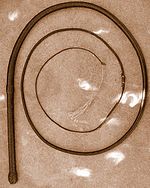
The slap-up sound a bullwhip makes when properly wielded is, in fact, a small sonic nail. The end of the whip, known as the "cracker", moves faster than the speed of sound, thus creating a sonic blast.[ii]
A bullwhip tapers downwardly from the handle section to the cracker. The cracker has much less mass than the handle section. When the whip is sharply swung, the momentum is transferred downwards the length of the tapering whip, the declining mass being made up for with increasing speed. Goriely and McMillen showed that the physical explanation is complex, involving the way that a loop travels down a tapered filament under tension.[12]
Run into also [edit]
- Cherenkov radiation
- Hypersonic
- Supershear earthquake
- Basis vibration boom
References [edit]
 | Wikimedia Commons has media related to Sonic nail. |
- ^ Haering, Edward A., Jr.; Smolka, James West.; Murray, James E.; Plotkin, Kenneth J. (1 January 2005). "Flight Sit-in Of Low Overpressure Due north-Wave Sonic Booms And Evanescent Waves". AIP Conference Proceedings. 838: 647–650. Bibcode:2006AIPC..838..647H. doi:ten.1063/1.2210436. hdl:2060/20050192479. Archived from the original on 13 February 2015.
- ^ a b May, Mike (September 2002). "Crackin' Skilful Mathematics". American Scientist. 90 (five): 415–416. JSTOR 27857718.
- ^ "Dorsum with a nail? Supersonic planes go ready for a quieter, greener comeback". Horizon (online magazine) . Retrieved 6 May 2021.
- ^ "Fixing the Sound Barrier: Three Generations of U.South. Enquiry into Sonic Boom Reduction and what information technology means to the future" (PDF). Federal Aviation Assistants. 21 April 2010. Retrieved 5 May 2021.
- ^ Analyzing Sonic Boom Footprints of Military machine Jets, Andy S. Rogers, A.O.T, Inc.
- ^ a b c USAF Fact Sheet 96-03, Armstrong Laboratory, 1996
- ^ a b c d Seebass, Richard (1998). "Sonic Boom Minimization". Fluid Dynamics Research on Supersonic Shipping (PDF). Research and Engineering Organization of NATO.
- ^ NASA Armstrong Flight Inquiry Heart Fact Canvass: Sonic Booms
- ^ "NASA Awards Contract to Build Quieter Supersonic Shipping" (Press release). NASA. 3 April 2018. Retrieved 5 Apr 2018.
- ^ BBC News interview with former Concorde Pilot (2003).
- ^ Loubeau, Alexandra; Naka, Yusuke; Melt, Brian 1000.; Sparrow, Victor Westward.; Morgenstern, John M. (28 Oct 2015). "A new evaluation of noise metrics for sonic booms using existing data". AIP Conference Proceedings. 1685 (1): 090015. Bibcode:2015AIPC.1685i0015L. doi:x.1063/1.4934481. ISSN 0094-243X.
- ^ Alain Goriely and Tyler McMillen (2002). "Shape of a Cracking Whip" (PDF). Physical Review Letters. 88 (12): 244301. Bibcode:2002PhRvL..88x4301G. doi:ten.1103/physrevlett.88.244301. PMID 12059302.
[1]
Skilling, T., & WGN-TV, primary meteorologist at. (2021, Baronial twenty). Dearest Tom, are thunder decibel levels ever recorded?... Chicago Tribune. Retrieved February vi, 2022, from https://www.chicagotribune.com/news/ct-xpm-2001-09-20-0109200272-story.html (Sonic Blast decibel information)
Dunbar, B. (2015, May 27). What is Supersonic Flight? NASA. Retrieved February 6, 2022, from https://www.nasa.gov/audience/forstudents/5-8/features/nasa-knows/what-is-supersonic-flight-58.html#:~:text=Flight%20that%20is%20faster%20than,of%20sound%2C%20or%20Mach%205.
G., V. (2004, June 17). Multilevel optimization of a supersonic aircraft. France; ELSEVIER. Play a joke on, C. (2021, June 4). United plans supersonic passenger flights past 2029. BBC News. Retrieved February 8, 2022, from https://www.bbc.com/news/technology-57361193 Cooper, J. E. (2001). Aeroelastic response. Encyclopedia of Vibration, 87–97. https://doi.org/x.1006/rwvb.2001.0125
[ii]
External links [edit]
- Archived at Ghostarchive and the Wayback Automobile: "Audio Recording of SR-71 Blackbird Sonic Booms – YouTube". YouTube . Retrieved 12 February 2015.
- Boston Earth profile of Spike Aerospace planned S-521 supersonic jet
- ^ Banse, Tom. "Supersonic Jets Could Return To Inland Northwest Skies". OPB. OPB. Retrieved 8 Feb 2022.
- ^ F.S., Billig (August 1993). Research on Supersonic Combustion (Book 9 ed.). John Hopkins University: John Hopkin University. p. four. Retrieved half-dozen February 2022.
Source: https://en.wikipedia.org/wiki/Sonic_boom
0 Response to "3 Things That Can Make a Sonic Boom"
Post a Comment