The Starry Night in the Exbit in the Museum of Modern Art
Vincent van Gogh's The Starry Nighttime (1889) is art history'southward virtually famous celestial scene—and one of the world'southward most beloved paintings to kicking (the miracle of the immersive Van Gogh feel seems to prove people want not just to look at it, but to be inside it, too).
It's non hard to come across why. The Post-Impressionist masterpiece hums with a swirling internal energy all its ain. In the foreground of the painting, a cypress tree flares upwardly against a night sky that reverberates with dazzling shades of bluish. Van Gogh conjures a heaven that isn't static and distant, but alive and moving, and the stars and moon glow with rings of luminous yellowish. Below this brilliant dark sky, a hamlet sleeps quietly, seemingly wrapped in the protection of the heavens, a lone church steeple straining upward to touch them.
Aside from its formal qualities, a lore has built up around the painting, due largely to the circumstances surrounding its cosmos. Van Gogh fabricatedThe Starry Night at Saint-Paul-de-Mausole asylum in Saint-Rémy, in southern France, where he had voluntarily admitted himself post-obit a manic episode in which he infamously mutilated his own ear. Many have interpreted the painting as Van Gogh's contemplation of his ain bloodshed—the cypress tree was a common symbol of death and mourning, and the artist often affiliated the stars with the afterlife. In one letter of the alphabet to his blood brother Theo, he wrote, " But the sight of the stars e'er makes me dream… Why, I say to myself, should the spots of light in the firmament be less accessible to us than the blackness spots on the map of France? Just as we have the train to become to Tarascon or Rouen, we take expiry to go to a star."
Merely while the creative person'due south masterpiece certainly lends itself to emotive interpretations, it was also the highly considered effect of one of the well-nigh productive periods of his career. The Saint-Paul-de-Mausole asylum was a progressive institution in which patients were encouraged to spend time in nature, and the creative person's blood brother ensured his brother was given a studio and ample time to pigment.
At that place, in the shrouded safety of the asylum, Van Gogh experienced some of his virtually bright—and peaceful—moments. He painted his famous Irises inside his first several days there, and he would proceed to paint The Starry Night over just a few days in June of 1889.
In spite of the painting's ubiquity in pop culture, The Starry Night is still total of wonderful surprises that accept either been disregarded or misunderstood. Nosotros've institute iii fascinating facts that just might make you see information technology differently.
Van Gogh Painted The Starry Nighttime During the Daytime—And Took Some Creative License With the Cosmos
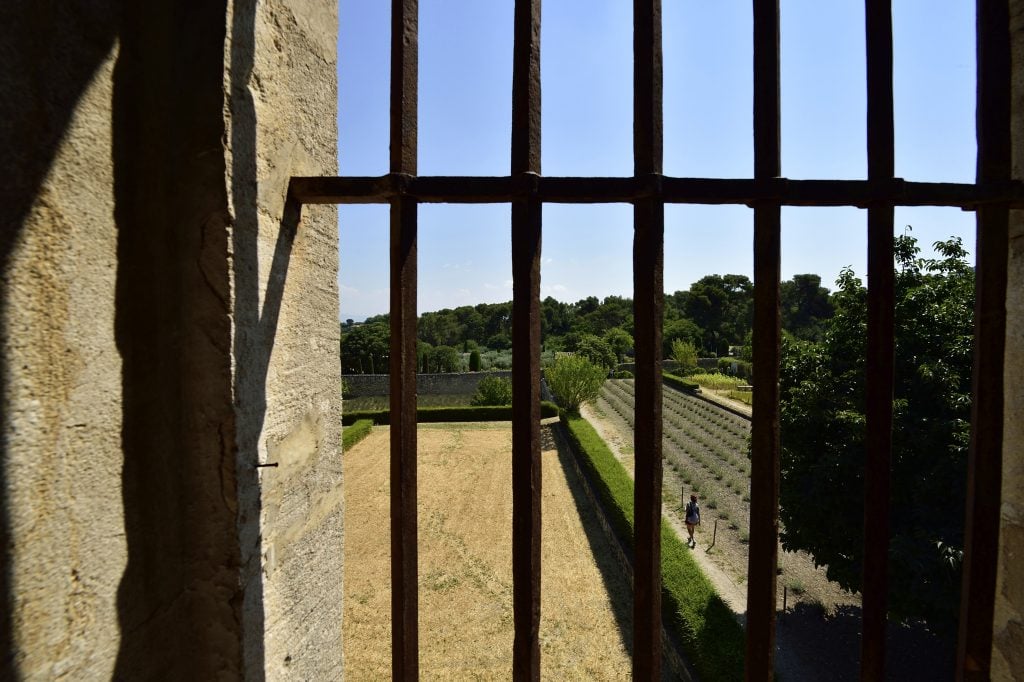
The gardens of the monastery of Saint-Paul-de-Mausole psychiatric hospital, equally seen from a jail cell, Saint-Remy-de-Provence, France. Photograph: Albert Ceolan/De Agostini Motion-picture show Library via Getty Images.
One mutual misconception is that Van Gogh painted his magnum opus while looking out the window from his room in the asylum. While perhaps less romantic a vision, the artist in fact had a separate painting studio at Saint-Paul-de-Mausole where he worked during the day. This studio had no windows at all. Van Gogh did, even so, brand sketches from his bedroom window, and in The Starry Night ,one does meet the sloping hills of the Alpilles, a low mountain range, visible from his room.
All in all, however, the scene is a composite of accurate and invented attributes. Van Gogh inserted the view of the village, for instance, and taken similar liberties with the sky. Some details are historically authentic: The brilliant orb at the center-left of the painting has been identified by astronomers as the the planet Venus, which would have been specially vivid in the summer of 1889. Constellations including Capella, Cassiopeia, and Pegasus are also correctly positioned, with some astronomers having gone so far equally to identify the celestial scene as taking identify at 4 a.m. on June xix, 1889. Notwithstanding, just as with his depiction of the village, Van Gogh did have a bit of creative license. The moon is shown in the crescent phase, however, information technology would accept been in the less evocative waning gibbous phase at the time he painted it.
Its Radiance Is an Optical Illusion
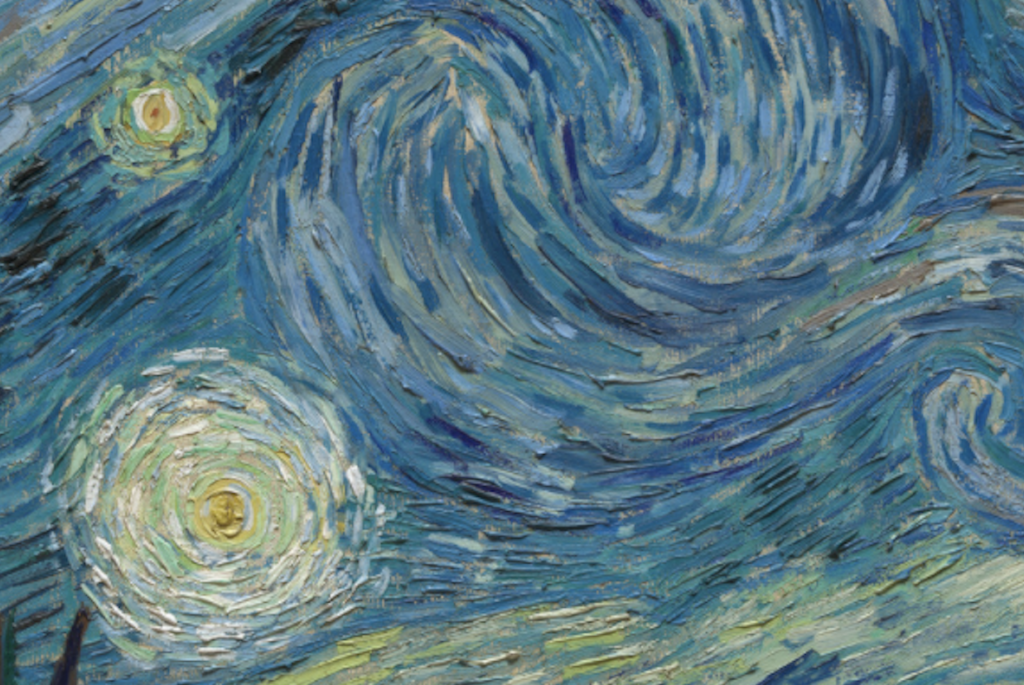
Particular of The Starry Dark (1889).
While Van Gogh is often portrayed as the quintessence of the lone, tortured artist, he was annihilation but asunder from gimmicky conversations most the latest developments in the arts. His discursive messages to his friends Paul Gaugin and Émile Bernard discussed the latest color theories, including the principles of color contrasts that Van Gogh derived from his hero, the Neoclassical artist Eugène Delacroix.
In 1889, he wrote to Theo about his recent paintings, "When you run into them some time […] I shall be able to give yous a better idea of the things Gauguin, Bernard and I often used to talk about and occupy ourselves with than I tin do in words; information technology is not a return to Romanticism or to religious ideas, no. Simply via Delacroix one tin can limited more of Nature and the country, by means of color and an individual cartoon style, than might appear."
For Van Gogh, colour was a vehicle for expressing emotion, and the brilliantly hued canvases of his late career succeed in big part to the availability of new hues of paint on the market. It is the intensity of light in those colors on the canvas that gives The Starry Night its unique glow. The contrasts between dashes of paint create an optical effect known as luminance, in which the brain experiences two simultaneous and competing sensory impulses. Just put—one office of the encephalon focuses on light and motion, but sees color less distinctly. Another part of the brain, all the same, will perceive each of the contrasting colors. Van Gogh'south bold, lite-filled brushstrokes signal both of these experiences, creating the flickering sense for which the painting is so famed.
Hokusai's Keen Wave Was an Inspiration
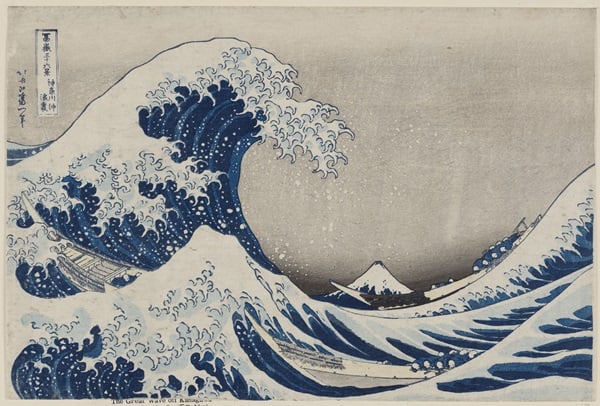
Under the Wave off Kanagawa (Kanagawa-oki nami-ura), also known as the Swell Wave, from the series "Xxx-six Views of Mount Fuji." Collection of the Museum of Fine Arts, Boston.
Like many Impressionist and Mail service-Impressionist artists, Van Gogh was deeply influenced by the Japanese woodblock prints that were imported in Europe during the 19th century. While nosotros can credit these prints—known as ukiyo-eastward in Japan—with more general trends, such as a flattening of planes and use of aerial perspective in Western art, in the example of The Starry Nighttime, one sees a more directly connection. Many fine art historians believe Van Gogh was direct inspired by Katsushika Hokusai's The Bang-up Wave Off Kanagawa. Adjacent, the similarities between cresting tidal waves and the swirling heavens are easy recognize. Van Gogh even wrote to Theo about the print, saying with a sense of awe, "These waves are claws, the boat is caught in them, you tin can feel it." Though he did non accept a impress of the Bang-up Wave with him at the aviary, historian Martin Bailey believes he may accept worked from memory, calling The Starry Night "a work of imagination with all sorts of conscious and unconscious elements which must have come up into Vincent's mind when he was doing the painting."
Follow Artnet News on Facebook:
Want to stay ahead of the art world? Subscribe to our newsletter to go the breaking news, heart-opening interviews, and incisive critical takes that drive the conversation forward.
Source: https://news.artnet.com/art-world/3-things-about-vincent-van-goghs-starry-night-2020713
0 Response to "The Starry Night in the Exbit in the Museum of Modern Art"
Post a Comment